“The morning of November 16, 1880, Wilhelm Friedrich Kühne (1837–1900), a professor of physiology at the University of Heidelberg, dissected the head of an executed murderer in his dark room…to remove the eye and develop an image from the retina of the last thing this man saw.” (from Strange Remains)
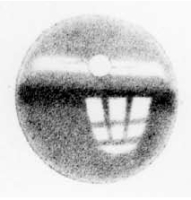 Optography, or the process of retrieving an image from the retina of an eye as though it were a piece of film, is an eddy in the river of forensic science which tends to return in fiction despite being debunked repeatedly in real life. Why? Because it’s a cool idea, which is probably the reason Wilhelm Kühne tried it. Did he get a picture, though? Well actually yes, he did – just not from his human subject. He started out experimenting with rabbits and proved his theory that the photosensitive pigment in the eye could function like a photographic negative under ideal conditions. So then he tried it on the eyes of a man who had just been executed…and got nothing usable. Because the problem with optography isn’t that it’s fake or has no basis in fact, it’s that human eyes may be decent enough cameras but the human retina makes crap film.
Optography hasn’t been debunked in the sense that it’s complete nonsense and doesn’t work at all;, its the use of optography in forensics that has been debunked – as in, you can’t get a ‘photograph’ (optogram) from a dead human eyeball that shows an actual image you could use as evidence. The theory behind optography is correct as far as how and why it works, as you can see in the image to the left, which is one of Kühne’s rabbit optograms and pretty clearly shows the window the rabbit had been staring at. The experiment Kühne tried in Heidelberg, however, was conducted under as close to ideal conditions as possible and still only yielded a picture of an unidentifiable blob. So in the real world, optography is just a scientific curiosity, not a useful process.
In fiction, however? You can do whatever you want, and you may want to incorporate optography into a story because it’s just such an intriguing idea – the last image a person saw being recorded in their eyes, just waiting for someone to come along and see it. Especially if you’re writing a period story, since the idea of optography was popular throughout the mid to late 1800s and a lot of people were talking about it. To avoid complaints from science purists, though (in author terms, ‘nitpickers’ – of course we mean that affectionately!), be sure you address at least one or two of the limitations of the actual science of optography in your story:
- Decomposition setting in = no optogram
- Getting a decent optogram requires ideal conditions at or immediately following death
- The best images come from rabbits, not humans – no one has ever gotten a clear image from a deceased human’s retina
- In a human eye, the spot in the center of the retina they’re trying to get the image from is less than 2 millimeters in diameter
- Optograms fade quickly
- There hasn’t been serious research conducted on optography since the mid 1970s
For some fun research on this subject, check out The Museum of Optography, a series of art exhibitions by Derek Ogbourne.
Author Randall Garrett made it work with sorcery, and quite believably, too. His stuff is sometimes hard to find nowadays, but worth the effort. His alternate Earth (where everything we think of as scientific works instead by magic) is fascinating.
We have those books, but I’ve never gotten around to reading them. Heinlein had a story something like that too, it was called Magic, Inc. – it’s one of my favorites.
Oh yeah, I’ve read my way thru Heinlein. I even like most of it. These are quite different but well worth it. They start with the idea that Richard the Lion-Hearted didn’t die in 1199 so the Plantagenets still rule. The Catholic church is still the universal religion and technology is based on magic. I’d start with “Murder and Magic” which is a collection of four short novellas. Garrett has a tendency to toss you into the plot and let you learn things about his universe as you go thru the story. Lord Darcy, the investigator, works for the King but is not magical himself. His assistant Master Sean is. Well written and fun to read.